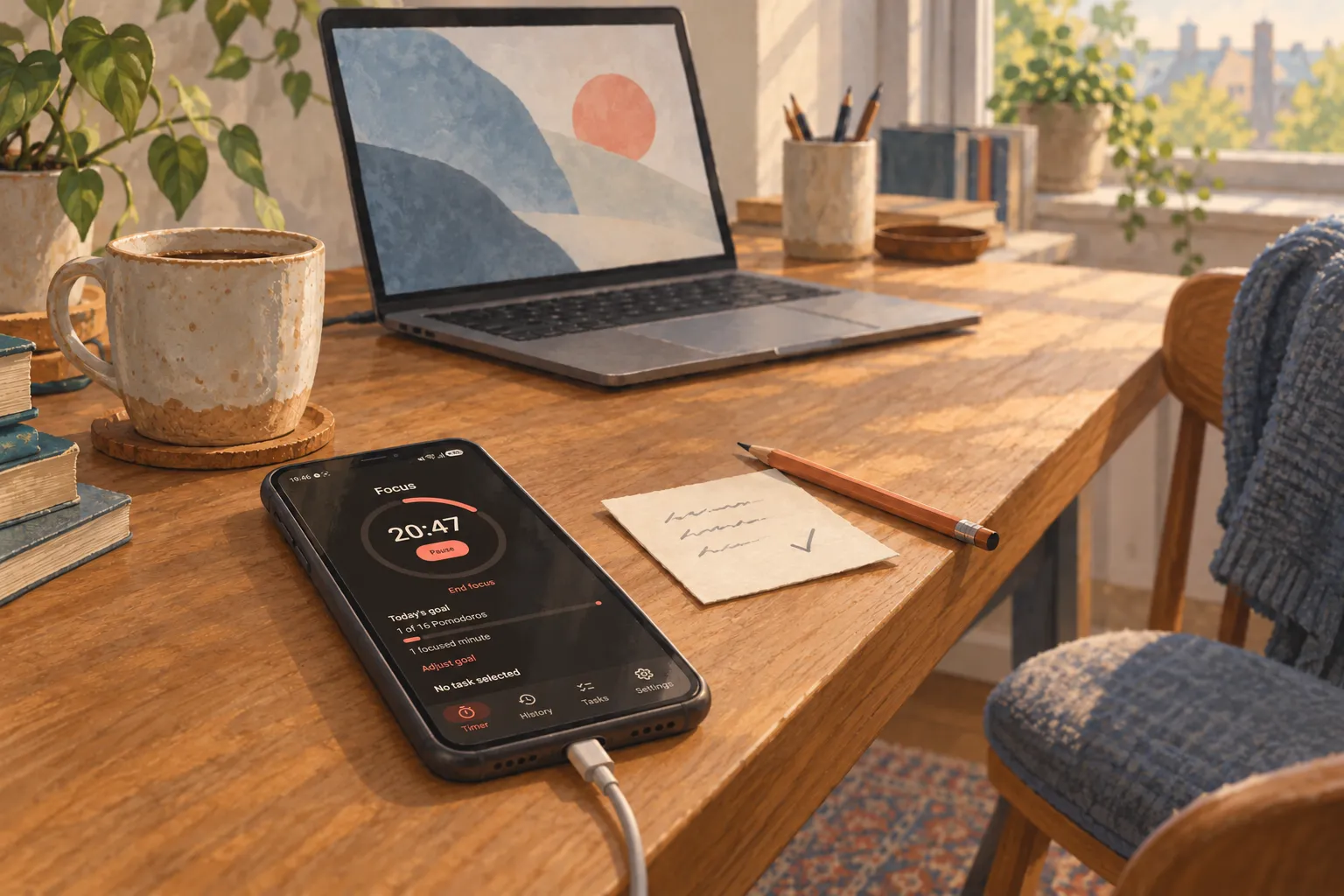
An illustration of the timer interrupting a stretch of work that could otherwise run on.
I Can Keep Working for Hours. The Timer Reminds Me to Post.
On this page
I do not struggle to keep working.
Give me a clear task and a quiet stretch of time and I can sit with it for a couple of hours without much trouble. The harder part, in the arrangement I work in now, is remembering to stop long enough to tell anyone what happened.
That is where the Pomodoro Technique fits my day. Not as a miraculous focus method. As a reminder to post a short update, leave a clear next step, and glance at whether the work still matters.
In this working arrangement, a Pomodoro stands for 30 minutes: roughly 25 minutes of work and a five-minute break.
I usually try to stop around the 25-minute mark and write a short task update.
Sometimes I need another minute or two to reach a sensible stopping point. I try not to go more than about three minutes past the timer before I post. I just try to stop soon enough that the update still happens.
The updates themselves are a requirement for getting paid in this particular arrangement. That is a workplace rule, not a rule of the Pomodoro Technique, and not a universal billing practice.
What happens when the timer buzzes
In the best version of the day, the phone buzzes on the desk, I finish the thought I am in, and I write two lines about what I did and what comes next.
In the ordinary version, I still write the update, then sometimes go straight back to the work without taking the break I meant to take. During deep development that happens more often than I would like to admit. Posting is required. Rest is recommended. I am better at the first than the second.
There is also the version where the timer sounds and I think I will just finish this one thing. Ten or fifteen minutes later I wonder why it has not buzzed again, then realise I never posted the update or restarted the timer.
That is not a technique. That is just me.
The actual update
Most of the time the update is short. Something like:
I have updated the header sizes and checked both desktop and mobile view for alignment.
NPS: update the homepage carousel with the new banner.
In that example, NPS means the next planned step. It is not Net Promoter Score. It is the next thing I intend to do.
That second line matters more than it looks. When I come back from a break, or after being pulled into a meeting, I do not need a large handover document. I need the last thing I was thinking, written down while it was still obvious.
If there is a blocker, the update can run longer. It may tag someone who needs to help. Most days it does not. Most days it is just done and next.
Posting is primarily a payment requirement now. The useful side effect is that the same two lines also help me restart my own work.
The break, then the priority check
When I make myself take the break properly, I leave the desk. I might go to the kitchen, get a drink, look for a snack, walk around the house, stretch my legs and take a breath. That part is the break.
When I come back, I briefly check work chats and the CRM for anything urgent before I continue. Checking messages is not rest. It is a separate checkpoint that happens after the break.
Sometimes that checkpoint shows that priorities have changed.
Without it, I could spend several hours concentrating on a task without seeing an instruction to stop or switch. The timer does not guarantee I catch every urgent message, and it does not limit wasted effort to exactly one Pomodoro. It does interrupt the stretch often enough that I am less likely to discover a change only after a long, focused afternoon on the wrong thing.
When uninterrupted work becomes unnecessary work
This has happened in practice. Sometimes the boss needed something else attended to immediately. On another occasion, a vendor ended an agreement and instructed the business to remove media relating to them from its website. The change meant the task I was working on was no longer needed.
The point is not the vendor, the project, or the media. Focused effort is only useful while the work still exists. A reminder to look up from the screen can save you from polishing something the world has already cancelled.
Why I use my own timer
There are already many Pomodoro timers. I wanted to build something, so I made my own rather than hunting through alternatives. I now use it every day.
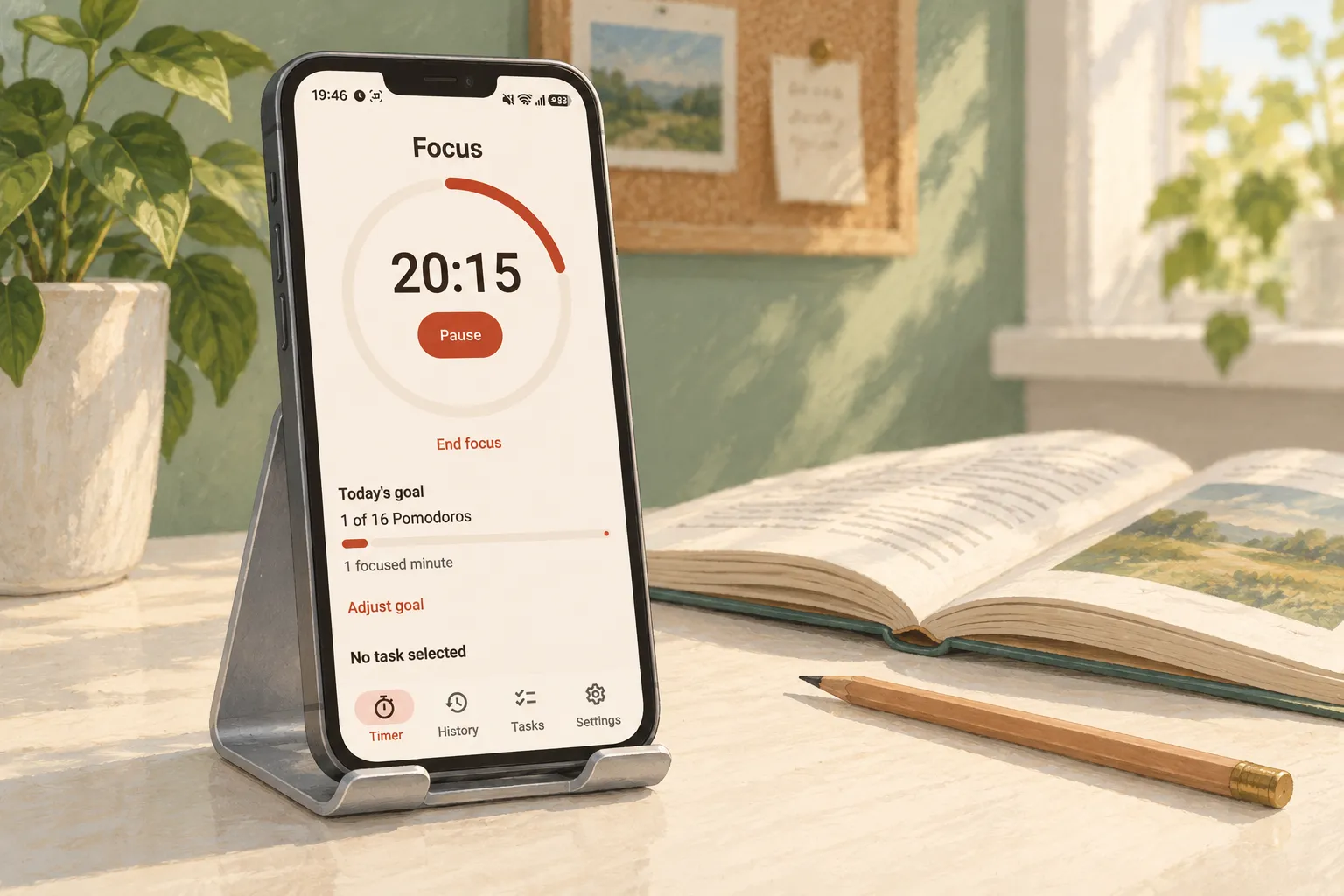
It runs on my phone. A friendly buzz from the phone on the desk is a useful, relatively unobtrusive reminder. That is the whole practical point for me.
The Focus timer on the phone that buzzes when it is time to post an update.
I built Pomodoro Tracker (opens in a new tab) through Bez Leda Studios, and it is the timer I use myself. I am considering improvements, but those belong to another story.
What I am actually recommending
If you already concentrate easily, you may not need a timer to force focus. You might need one to interrupt yourself before two quiet hours pass without a record of what you did, what comes next, or whether the work still matters.
My version of Pomodoro is shaped by the job in front of me. Post the update. Leave a next step. Take a real break when you can. Then check whether the day has moved.