An illustration of looking past the pitch to the product on the screen.
I Usually Blame the Marketing
On this page
When I release something and almost nobody uses it, my first instinct is usually to blame the marketing. Maybe that is convenient. Maybe sometimes the product is rubbish.
But I do put a lot of time into testing what I build. I think about what problem it solves, whether it has a purpose, what could make somebody's time easier, and what I could improve next. So when something launches quietly, I do not immediately think:
Well, clearly nobody wanted this.
I usually think:
Nobody knew it existed.
Building something and reaching people are completely different skills
This is probably one of the biggest things I am learning. I can build the product. That does not mean I know how to get people through the door.
I do not already have a massive audience waiting for the next thing I release. I cannot put an app online, post one link somewhere and expect thousands of people to appear. You have to know who the thing is for. Then you have to figure out where those people are. Then you have to find some way of telling them about it without becoming the annoying person who appears in every community purely to drop a link. That part is much harder than I used to give it credit for.
Promotion groups are not necessarily an audience
There are plenty of places built around people promoting their work. The problem is that promotion can very easily become an exchange rather than genuine interest.
I'll look at your app if you look at mine.
I'll like your post if you like mine.
I'll follow your account if you follow mine.
The numbers might move, but what have you actually learned? If somebody clicks because they want you to click their project afterwards, that is not necessarily a potential user. And the feedback you get can become equally meaningless — everyone is being nice because everyone wants something.
What I really want is somebody who has the problem my product is supposed to solve, finding it and deciding whether it actually helps them. That is a much harder person to reach.
An illustration of cutting through noisy claims to look at the work itself.
Of course, sometimes the product probably is the problem
I cannot just blame marketing forever. Maybe the idea is not particularly good. Maybe the app works perfectly but nobody needs it. Maybe there are already thousands of apps doing essentially the same thing.
That is especially awkward with software because it feels like almost everything already exists in some form. Build a productivity app and there are thousands. Build a timer and there are thousands. Build an ecommerce tool and somebody somewhere probably already has a version of it. So maybe poor results are not always about promotion. Maybe I have entered a market where the user already has 30 alternatives.
Maybe I am just late
This thought comes up occasionally too. Am I too late for everything? There are established Android developers, huge Shopify apps, WordPress plugins with years of history, software companies with entire marketing departments. Then I turn up with a new listing and wonder why nobody immediately notices it.
But I also do not completely believe in being "too late." New products still appear. People still switch tools. Old products become bloated, expensive or abandoned. New problems appear. There is always room for something better, more focused or simply different enough. The difficult part is figuring out whether your idea is actually one of those things.
And then there is my patience problem
This might be the part where I cause some of my own problems. If I can build something, I want it live. Now. Not next month. Not after six weeks of launch planning. I have built the thing. It works. Open the doors.
WHERE IS EVERYONE?
Which is probably not the ideal product launch strategy.
Because getting something technically functional and getting something ready for strangers are not always the same thing. There is the listing, the screenshots, the explanation, the onboarding, testing with people who did not build it, figuring out where the audience actually is, working out how you are going to reach them, and maybe even building some interest before launch rather than immediately throwing the doors open and standing there waiting. If I rush that part, a decent idea can look like a failed one simply because I never gave it a proper chance.
Launching is part of building
I think this is the bit I need to get better at. I tend to think:
Build → publish → move on to improvements.
But maybe it needs to be:
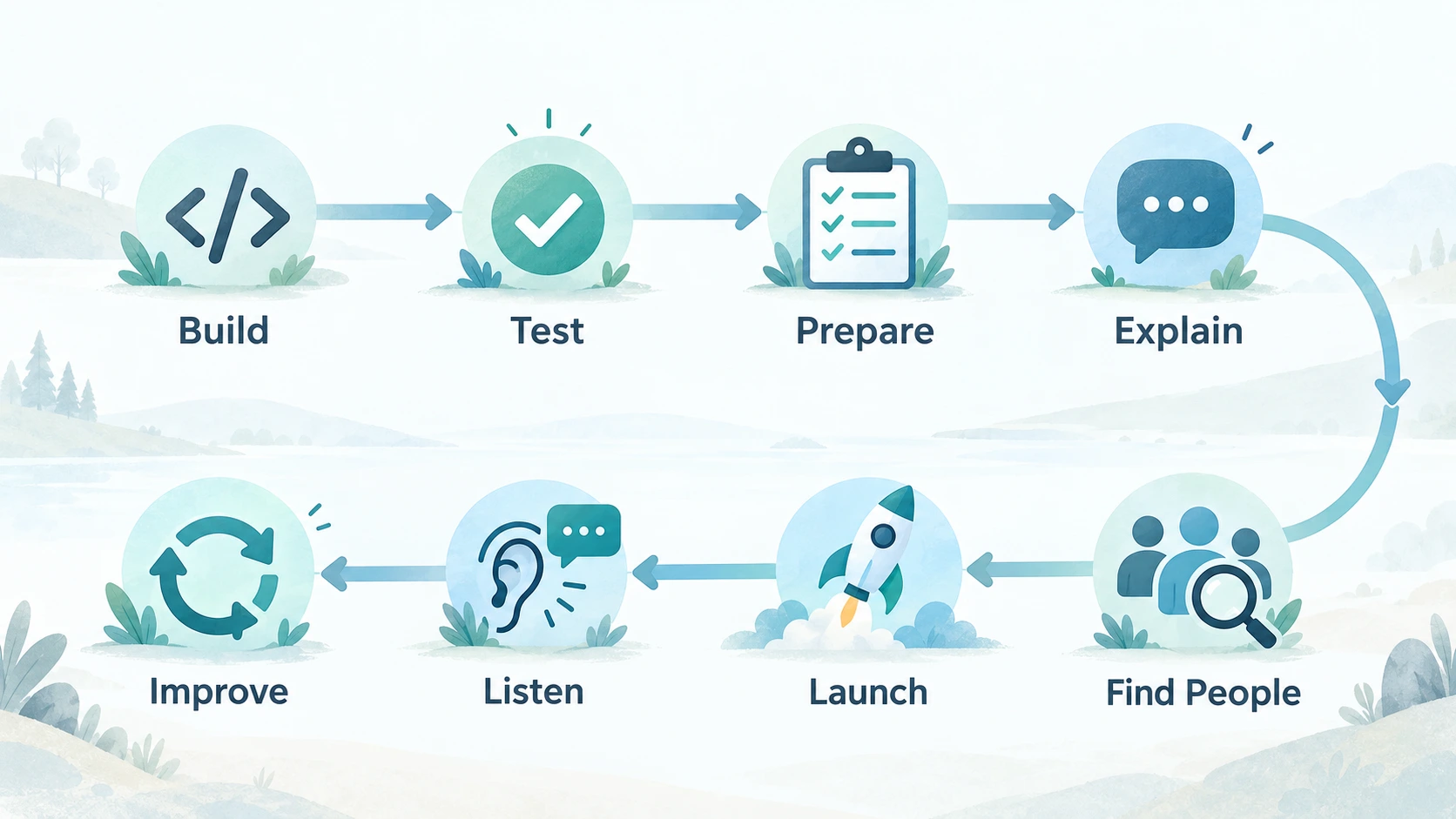
Build → test → prepare → explain → find people → launch → listen → improve.
Marketing is not something that happens after the product. It is part of getting the product into the hands of the people it was made for. That is a different kind of work, and currently it is probably the part I am weakest at.
An illustration of a longer loop than launch: listen, then improve.
So how do you know whether to keep going?
I am still figuring that out. Bad numbers do not necessarily mean a bad product. Good code definitely does not guarantee a good product either. And zero attention tells you surprisingly little if almost nobody was given a reason to pay attention in the first place.
I think the real question is whether I have properly tested the idea, not just the software. Did the right people see it? Did they understand what it was for? Did any of them actually want it? Did I give it enough time? Only after that can I fairly decide whether the problem was the product, the marketing or the timing.